Key takeaways
- A holiday gift to an employee that is not cash and has a low fair market value can be excluded from the employee's wages as a de minimis fringe benefit, according to IRS Publication 15-B for 2026.
- Cash and gift cards given to an employee are taxable wages in any amount, because the IRS says cash equivalents can never be excluded as a de minimis benefit.
- The IRS sets no dollar limit under which a gift to an employee is tax-free, and when a gift is too valuable to be de minimis its entire value is taxable, not only the part above some threshold.
- For 2026, an employer can withhold federal income tax from a holiday bonus at an optional flat 22%, and Social Security and Medicare taxes apply to the bonus as well.
- Gifts to clients follow a separate rule: under the current IRS Publication 463, a business can deduct no more than $25 for gifts given to each person during the tax year.
Are employee holiday gifts taxable? It depends on what you hand over, not on what it cost. A low-value gift that is not cash can be left out of the employee's wages. Cash and gift cards are wages in any amount, and a year-end bonus is wages with its own withholding rule. Gifts to clients are a different question with a different answer: a $25 cap on what you can deduct.
A cash gift or bonus paid in December 2026 is 2026 pay: Form W-2 for 2026 reports the wages and bonuses paid to an employee during the year. So the form of the gift is worth settling before you buy it.
Are holiday gifts to employees taxable?
Yes, unless a specific exclusion applies. The starting point in IRS Publication 15-B for 2026 is that any fringe benefit you give an employee is taxable and must be included in their pay unless the law specifically excludes it.
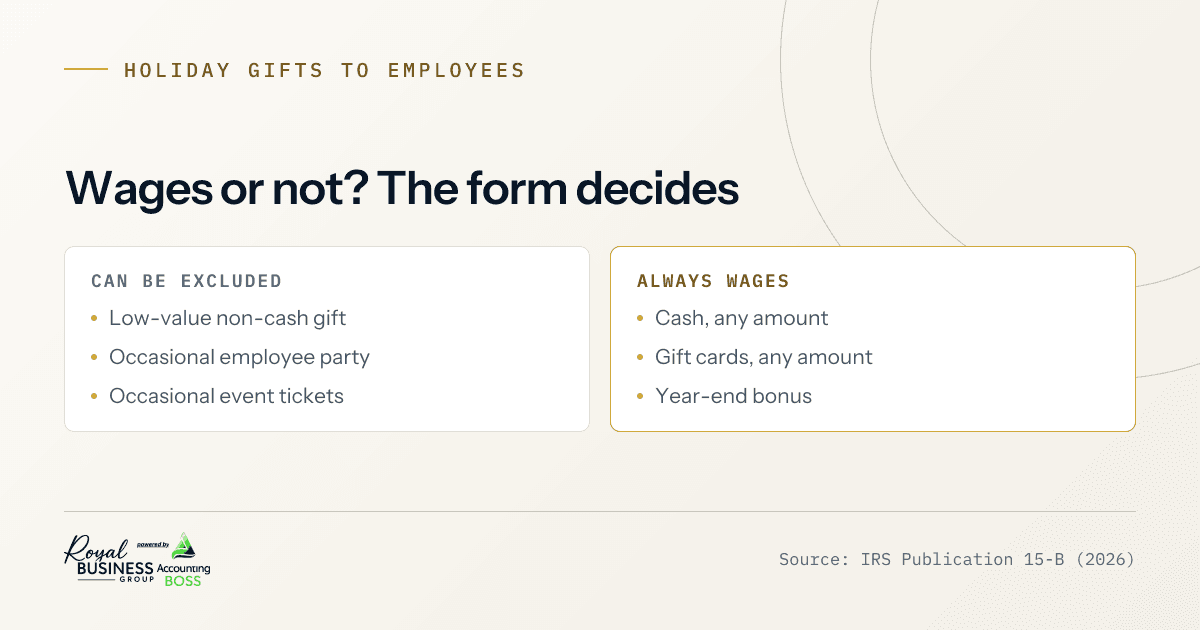
The exclusion that covers holiday gifts is the one for de minimis benefits. De minimis means minimal: property or a service worth so little, taking into account how often you give similar things, that accounting for it would be unreasonable or impractical. The IRS lists holiday or birthday gifts, other than cash, with a low fair market value as an example. Occasional parties for employees and their guests are on the same list.
| What you give an employee | Wages? |
|---|---|
| Non-cash holiday gift with a low fair market value | Can be excluded as de minimis |
| Occasional party or picnic for employees and their guests | Can be excluded as de minimis |
| Cash, in any amount | Always wages |
| Gift card or general-merchandise gift certificate, in any amount | Always wages |
| Year-end bonus | Always wages (a supplemental wage) |
A gift that qualifies as de minimis needs no reporting at all. A gift that does not qualify is included in wages on Form W-2 and is subject to income tax withholding and to Social Security and Medicare taxes.
Is a $25 gift card to an employee taxable?
Yes. The size of the card does not matter. Publication 15-B says cash and cash equivalents, a group that includes gift cards and gift certificates, are never excludable as a de minimis benefit, "no matter how little."
This is the rule owners most often get wrong, because a small gift card feels like a small gift. To the IRS it is a small amount of cash. Take a $50 gift card given to an employee in December 2026. The $50 is added to that employee's wages:
- Employee Social Security: $50 × 6.2% = $3.10
- Employee Medicare: $50 × 1.45% = $0.73 (rounded from $0.725)
- Federal income tax withholding on top of that
- Your matching Social Security and Medicare: $50 × 7.65% = $3.83 (rounded from $3.825)
The dollars are small. The point is that the card has to pass through payroll, which is easy to miss when it was bought with the office credit card.
Is there a dollar limit under which a gift to an employee is tax-free?
No. The IRS does not publish one, and Publication 15-B does not put a figure on "low" fair market value. Both value and frequency count, so the same item given every month is judged differently from one given once a year.
The nearest thing to a number is a single past case in which the IRS ruled that items worth more than $100 could not be de minimis. That tells you where one gift failed. It does not make gifts under $100 safe.
There is also no partial credit. When a gift is too valuable to be de minimis, the IRS says the entire value is taxable to the employee, not only the amount above some cut-off.
How much tax do you withhold from a holiday bonus?
For 2026, federal income tax can be withheld from a bonus at an optional flat 22%. Social Security and Medicare taxes apply as well. IRS Publication 15 for 2026 classes a bonus as a supplemental wage, meaning pay that is not regular wages, and taxable fringe benefits such as gift cards fall under the same rules.
The flat 22% is available when the bonus is paid separately from regular wages, or paid together with them but with each amount specified, and you withheld income tax from the employee's regular wages this year or last year. The other route is the aggregate method: add the bonus to the regular wages for that pay period, figure withholding on the total, and subtract what was already withheld. If a bonus is simply folded into a regular paycheck with no amount specified, withholding is figured as if the whole payment were regular wages. The rate rises to 37% only on supplemental wages above $1 million paid to one employee in the year.
Either way, 22% is a withholding rate, not the tax the employee finally owes. That is settled on their own return.
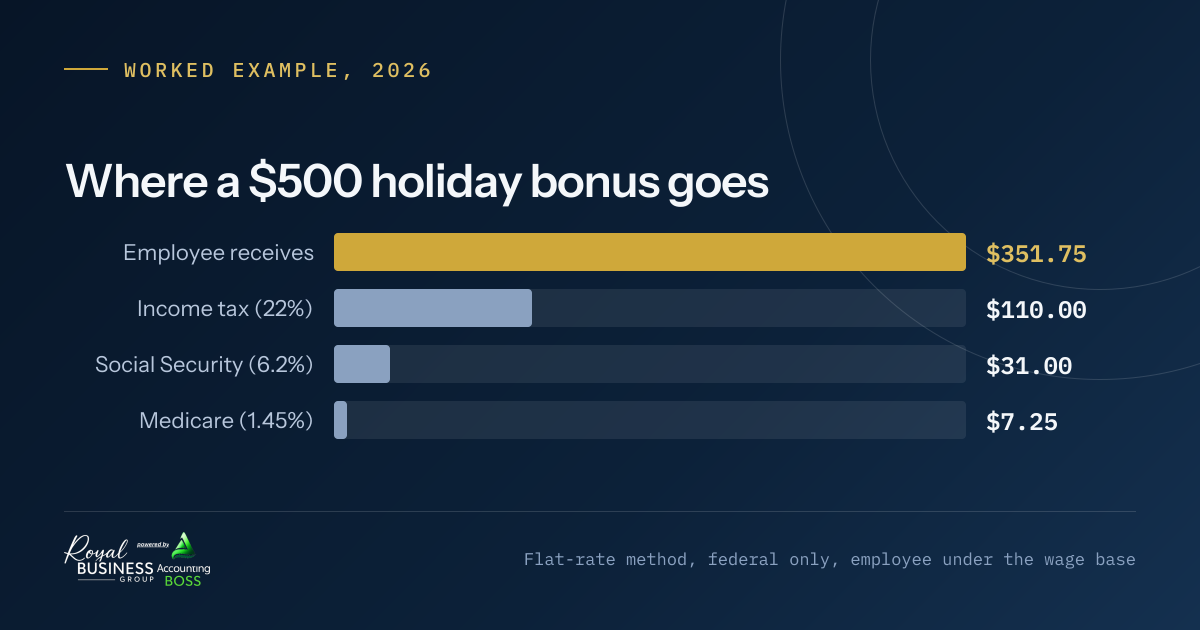
Here is a $500 bonus paid in December 2026 under the flat-rate method, for an employee who has not reached the $184,500 Social Security wage base for 2026:
- Federal income tax withholding: $500 × 22% = $110.00
- Employee Social Security: $500 × 6.2% = $31.00
- Employee Medicare: $500 × 1.45% = $7.25
- Total withheld: $110.00 + $31.00 + $7.25 = $148.25
- Employee receives: $500 − $148.25 = $351.75
Your side is the matching 7.65%: $500 × 7.65% = $38.25, so the bonus costs the business $538.25 in wages and federal payroll tax. Federal unemployment tax (FUTA), which only the employer pays, also applies to bonuses, but for 2026 it covers just the first $7,000 of each employee's wages for the year. By December most employees are past that, so a year-end bonus usually adds none.
Medicare tax has no wage limit. Social Security tax stops at the wage base, which is changing for 2027. The payroll taxes guide explains each of these taxes in full.
Does Florida reemployment tax apply to bonuses?
Yes, up to the annual limit. The Florida Department of Revenue's definition of wages for reemployment tax includes bonuses and the cash value of payments made in any medium other than cash. Reemployment tax is paid by the employer and is not withheld from the employee.
For wages paid in 2026, the tax applies to annual wages up to $7,000 per employee. An employee who has already been paid more than $7,000 in 2026 generates no further reemployment tax on a December bonus.
How much of a gift to a client can you deduct?
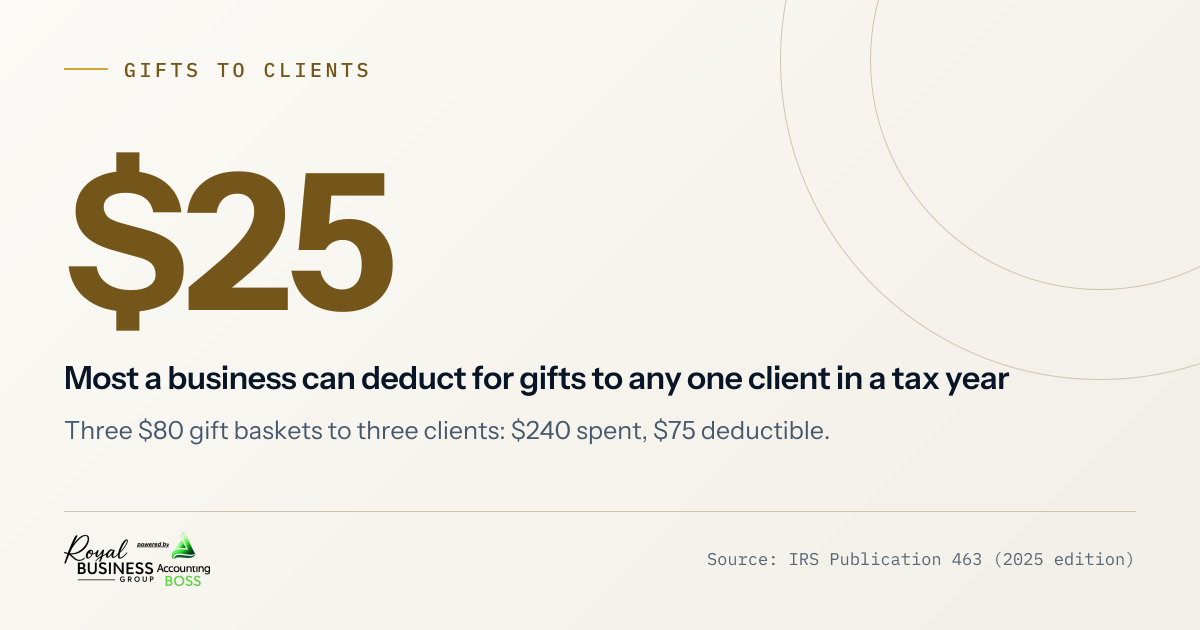
No more than $25 per person per tax year. This limit, from the current IRS Publication 463 (the edition for 2025 returns, the latest available), covers business gifts given directly or indirectly to each person. It caps the deduction, not the spending. The IRS's own example: three $80 gift baskets to three executives cost $240, and the deduction is $25 × 3 = $75.
Two details affect the count. Spouses are treated as one taxpayer, and so are a partnership and its partners. And packaged food or drink that you give a customer to use later is treated as a gift, not as entertainment.
The office party is separate again. Publication 463 says the 50% limit on meal deductions does not apply to recreational or social activities for employees, such as a holiday party. The business meal deductions guide covers where that 50% limit does apply.
If you would like a second pair of eyes on how gifts and bonuses are recorded before the year closes, Royal Business Group's bookkeeping and accounting service handles payroll and year-end books, and you can book a free 30-minute consultation.
Sources
Every figure and date above was checked against these before publishing.
- Publication 15-B (2026), Employer's Tax Guide to Fringe Benefits — IRS
- Publication 15 (2026), (Circular E), Employer's Tax Guide — IRS
- General Instructions for Forms W-2 and W-3 (2026) — IRS
- De minimis fringe benefits — IRS
- Publication 463 (2025), Travel, Gift, and Car Expenses — IRS
- Reemployment Tax: File and Pay (Definition of Wages) — Florida Department of Revenue
- Reemployment Tax Rate Information — Florida Department of Revenue
This is general information, not tax advice for your situation, and reading it does not make you a client. Rules and figures change — verify anything time-sensitive before you act on it. We'll talk it through with you free.
Common questions
A gift certificate that can be redeemed for general merchandise, or that has a cash-equivalent value, is taxable wages. The IRS says a certificate good only for a specific item of minimal value, given infrequently, may be excludable as a de minimis benefit, depending on the facts and circumstances. That is a possibility the IRS leaves open, not an automatic exemption.
Occasional tickets to a theater or sporting event are on the IRS's list of examples of de minimis benefits, which can be excluded from an employee's wages. Season tickets are on the IRS's list of benefits that are not de minimis. As with gifts, how often the benefit is given counts as well as its value.
No. A separate rule covers awards for length of service or safety achievement. Under IRS Publication 15-B for 2026, tangible personal property given as such an award can be excluded from wages up to $1,600 a year, or $400 if the award is not a qualified plan award, and the exclusion does not apply to cash or gift cards, or to gift certificates other than an arrangement that only lets the employee choose tangible property from a limited assortment the employer has preselected. It applies only to genuine service and safety awards, so it is not a way to make a holiday gift tax-free.
Generally not. Under the current IRS Publication 463, incidental costs such as engraving, packaging, insuring and mailing are generally not included in the cost of a gift for the $25 limit. Items costing $4 or less that carry the business's name permanently imprinted and are widely distributed, such as pens, are not treated as gifts for the limit at all.
IRS Publication 15 for 2026 lets an employer choose when to treat taxable non-cash fringe benefits as paid, such as each pay period or each quarter, as long as all benefits provided in a calendar year are treated as paid by December 31 of that year. Publication 15-B for 2026 adds an optional special accounting rule under which taxable non-cash benefits actually provided in November or December can be treated as paid in the following year, subject to conditions. Neither choice covers cash: a cash bonus is wages when it is paid, and the IRS classes a gift card as a cash equivalent.