

Key takeaways
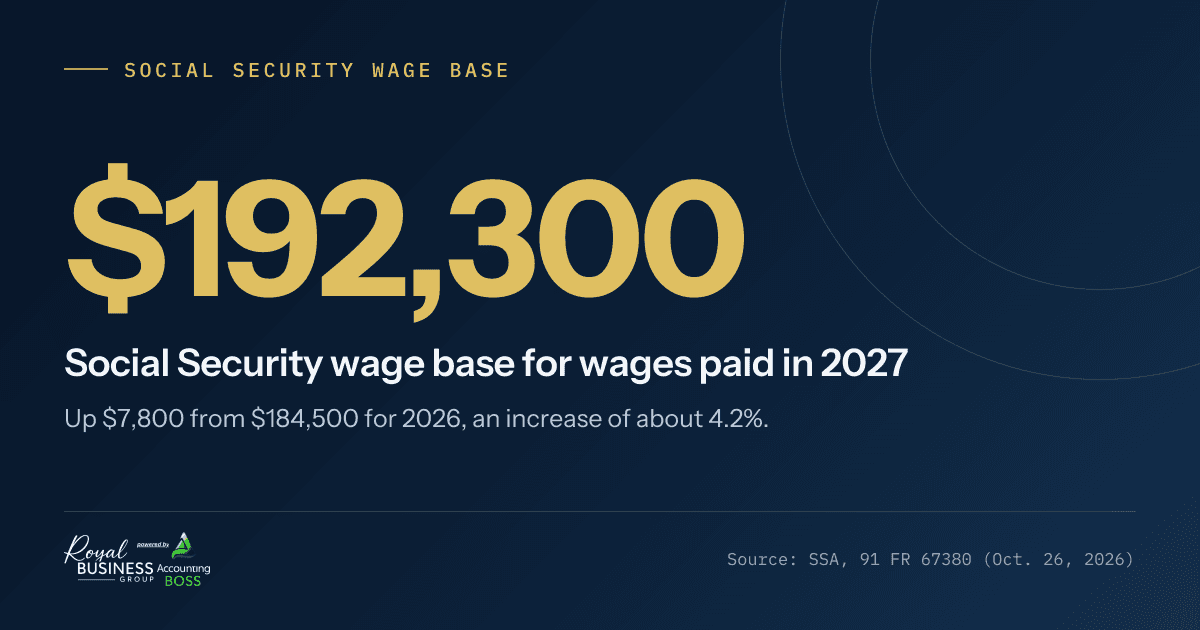
- The 2027 Social Security wage base is $192,300, up $7,800 from $184,500 for 2026, under a Social Security Administration notice published in the Federal Register on October 26, 2026.
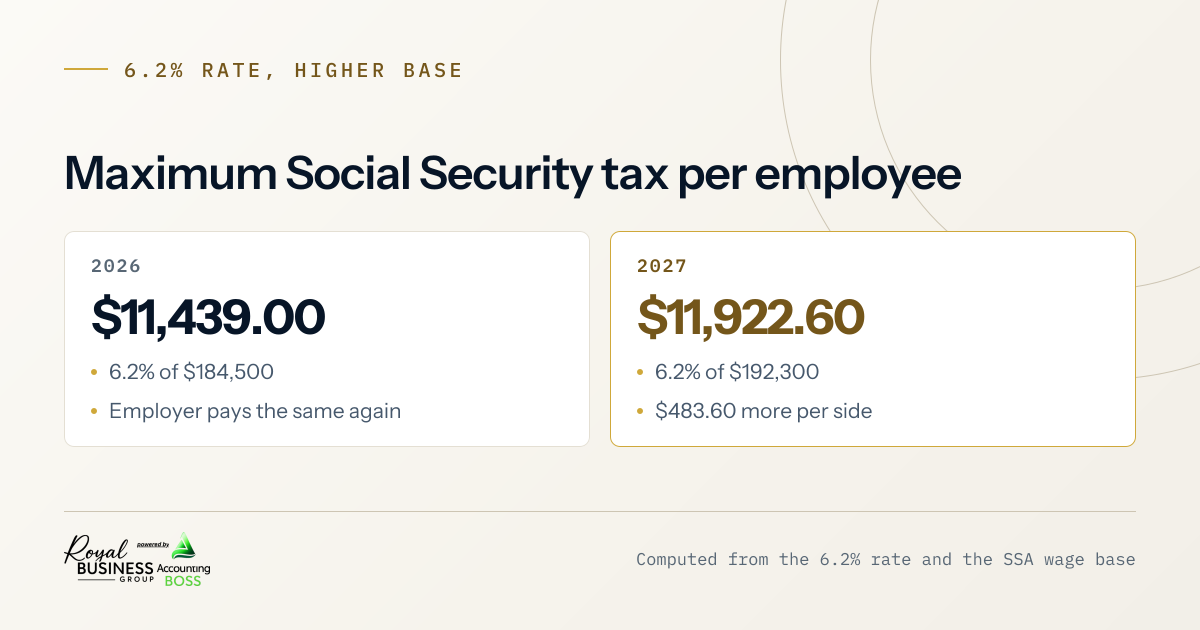
- At the 6.2% Social Security rate, the most one employer can withhold from an employee in 2027 is $11,922.60, which is $483.60 more than for 2026, and the employer pays the same amount again.
- The 2027 Social Security wage base applies to wages paid in 2027, so a paycheck dated in January 2027 for work done in December 2026 counts toward the 2027 limit.
- The Social Security wage base applies separately at each employer, so an employer generally keeps withholding even when a worker has already reached the limit at another job.
- Medicare tax has no wage base limit: the 1.45% employer and 1.45% employee Medicare tax applies to all covered wages, however high the pay.
The 2027 Social Security wage base is $192,300, up $7,800 from $184,500 for 2026. That is the most pay per person on which Social Security tax is charged, and the new figure applies to wages paid on or after January 1, 2027. The announcement changed the limit, not the rate, so the only people who pay more are those earning above $184,500 and the businesses that pay them: up to $483.60 more per person, on each side.
The figure is final, not a proposal. The Social Security Administration published it in the Federal Register on October 26, 2026. As of November 20, 2026, the IRS's employer pages still show only the 2026 limit, so the Federal Register notice is the place to confirm it.
What is the Social Security wage base for 2027?
It is $192,300. The wage base is the most annual earnings on which Social Security tax is paid, and also the most annual earnings counted toward a person's Social Security benefit. The IRS lists the Social Security rate as 6.2% for the employer and 6.2% for the employee, 12.4% in total, and that rate applies only up to the wage base.
| 2026 | 2027 | |
|---|---|---|
| Social Security wage base | $184,500 | $192,300 |
| Most Social Security tax one employer withholds from an employee (6.2%) | $11,439.00 | $11,922.60 |
| Most Social Security tax the employer pays for that employee (6.2%) | $11,439.00 | $11,922.60 |
| Most Social Security tax for a self-employed person (12.4%) | $22,878.00 | $23,845.20 |
| Earnings needed for one Social Security credit | $1,890 | $1,970 |
| Household employee threshold (cash wages in the year) | $3,000 | $3,100 |
The three tax maximums are arithmetic, the rate multiplied by the base, not figures quoted from a government page.
Nobody votes on this number. The base follows a formula in the law tied to the national average wage index, which was $72,800.33 for 2025, about 4.23% above the year before. The result is rounded to the nearest multiple of $300.
How much more Social Security tax will an employer pay in 2027?
At most $483.60 more for each employee paid $192,300 or more, and nothing more for anyone paid less than $184,500. The employee pays the same extra amount out of their own check.
- 2026: $184,500 × 6.2% = $11,439.00
- 2027: $192,300 × 6.2% = $11,922.60
- Difference: $7,800 × 6.2% = $483.60
Someone paid between the two figures pays 6.2% on the part above $184,500. A manager paid $190,000 in 2027 is $190,000 − $184,500 = $5,500 over the old limit, so $5,500 × 6.2% = $341.00 more from the manager and $341.00 more from you.
Two rules decide how this shows up in payroll.
The test is when wages are paid, not when the work was done. A paycheck dated in January 2027 for work done in December 2026 counts toward the 2027 base.
Withholding stops when the employee reaches the base. Under IRS Publication 15, an employer stops collecting the employee's share of Social Security tax once that employee's wages for the year reach the wage base, and the employer's own share stops at the same point. The current edition is the one for 2026, so it prints $184,500. The mechanism is the same for 2027 with $192,300.
An employee already hit the limit at another job. Can you stop withholding?
No. The wage base applies separately at each employer, and Publication 15 says an employer generally must keep withholding even if the worker has had the maximum withheld somewhere else.
The employee is the one who gets relief. A person with more than one employer who had more than the maximum withheld in total may be able to claim the excess as a credit on their own income tax return. The employer's matching share is not part of that credit. If a single employer withheld too much, that employer should correct it.
There is one exception worth knowing if you bought a business during the year. When an acquisition meets certain requirements, wages the previous owner paid count toward the wage base for the new owner.
Does Medicare tax stop at the wage base too?
No. Only the Social Security tax has a wage base limit. Medicare tax is 1.45% for the employer and 1.45% for the employee, and all covered wages are subject to it for the whole year. So when a high earner's Social Security withholding stops partway through the year, the Medicare line on the pay stub keeps going.
How does the 2027 wage base work if you are self-employed?
You pay both halves. The self-employment tax rate is 15.3%: 12.4% for Social Security plus 2.9% for Medicare. Only the 12.4% part stops at the wage base. For 2027 that part tops out at $192,300 × 12.4% = $23,845.20, which is $967.20 more than the 2026 maximum of $22,878.00.
Self-employment tax is generally figured on 92.35% of net earnings, so a self-employed person with no wages reaches the 2027 base at roughly $208,230 of net profit ($192,300 ÷ 0.9235). That is our arithmetic and an approximation, not an official figure.
If you have a job and a side business, the wage base is one combined limit. Wages count first, and the 12.4% applies only to the room that is left. Say you are paid $150,000 in wages in 2027 and your side business nets $60,000:
- Earnings subject to self-employment tax: $60,000 × 92.35% = $55,410
- Room left under the base: $192,300 − $150,000 = $42,300
- Social Security part: $42,300 × 12.4% = $5,245.20
The 2.9% Medicare part still applies to all $55,410. If your wages alone reach the base, you pay none of the 12.4% on your business earnings. Half of your self-employment tax is deductible when figuring adjusted gross income.
What changes for an S corporation owner?
Only owners paid more than $184,500 in wages see a difference. An S corporation must pay reasonable compensation as wages to a shareholder who works in the business, before non-wage distributions, and those wages are what the wage base applies to. Because the owner sits on both sides of the paycheck, the most the 2027 increase can add is $483.60 × 2 = $967.20.
The rule for setting that salary is still reasonable compensation, not the wage base. The S corporation election guide explains how that works, and the S corp savings calculator is a planning tool for comparing salary scenarios.
What to check before the first January payroll
- Ask your payroll provider, or look in your payroll software, to confirm the 2027 limit of $192,300 is loaded before the first paycheck dated in January.
- Budget up to $483.60 more in employer tax for each person paid above $184,500.
- Treat a January paycheck for December work as 2027 wages.
- If you are self-employed, use the 2027 base when you work out your quarterly estimated taxes for 2027.
The payroll taxes guide covers the rest of the mechanics, including deposits and forms. If you would like help working the higher base into a 2027 payroll budget or an owner salary, Royal Business Group's bookkeeping and accounting service is the place to start, and you can book a free 30-minute consultation.
Sources
Every figure and date above was checked against these before publishing.
- Cost-of-Living Increase and Other Determinations for 2027 (91 FR 67380, FR Doc. 2026-21796, October 26, 2026) — Social Security Administration (Federal Register)
- Topic no. 751, Social Security and Medicare withholding rates — IRS
- Publication 15 (Circular E), Employer's Tax Guide (for use in 2026) — IRS
- Self-employment tax (Social Security and Medicare taxes) — IRS
- Topic no. 554, Self-employment tax — IRS
- Topic no. 608, Excess Social Security and RRTA tax withheld — IRS
- S corporation compensation and medical insurance issues — IRS
This is general information, not tax advice for your situation, and reading it does not make you a client. Rules and figures change — verify anything time-sensitive before you act on it. We'll talk it through with you free.
Common questions
The Social Security wage base is set by a formula in the law that is tied to the national average wage index, not by a fresh policy decision each year. The Social Security Administration runs the formula and publishes the result in the Federal Register. For 2027, the index it used was about 4.23% higher than the year before, and the result was rounded to the nearest multiple of $300, giving $192,300.
Yes. For 2027, Social Security and Medicare taxes apply to a household worker who is paid $3,100 or more in cash wages during the year. The 2026 threshold is $3,000. The figure comes from the same Social Security Administration notice that set the 2027 wage base.
A self-employed person on a fiscal year uses the wage base in effect at the start of that tax year for the whole tax year. The 2027 base of $192,300 applies to self-employment income earned in tax years beginning in 2027. Most sole proprietors use the calendar year, so for them it is simply the 2027 return.
In 2027 it takes $1,970 of covered earnings to earn one Social Security credit, which the Social Security Administration calls a quarter of coverage. That is up from $1,890 in 2026. This matters mostly to owner-employees on small salaries and to people with small amounts of self-employment income.
No. Employers must withhold the 0.9% Additional Medicare Tax on wages paid to an employee above $200,000 in a calendar year, regardless of the employee's filing status, and there is no employer match for it. That $200,000 withholding threshold is a separate rule and was not part of the Social Security Administration's 2027 notice.