Key takeaways
- The IRS announced the 2027 tax inflation adjustments on November 5, 2026 in Revenue Procedure 2026-35, and they generally apply to tax years beginning in 2027, not to the 2026 return filed in spring 2027.
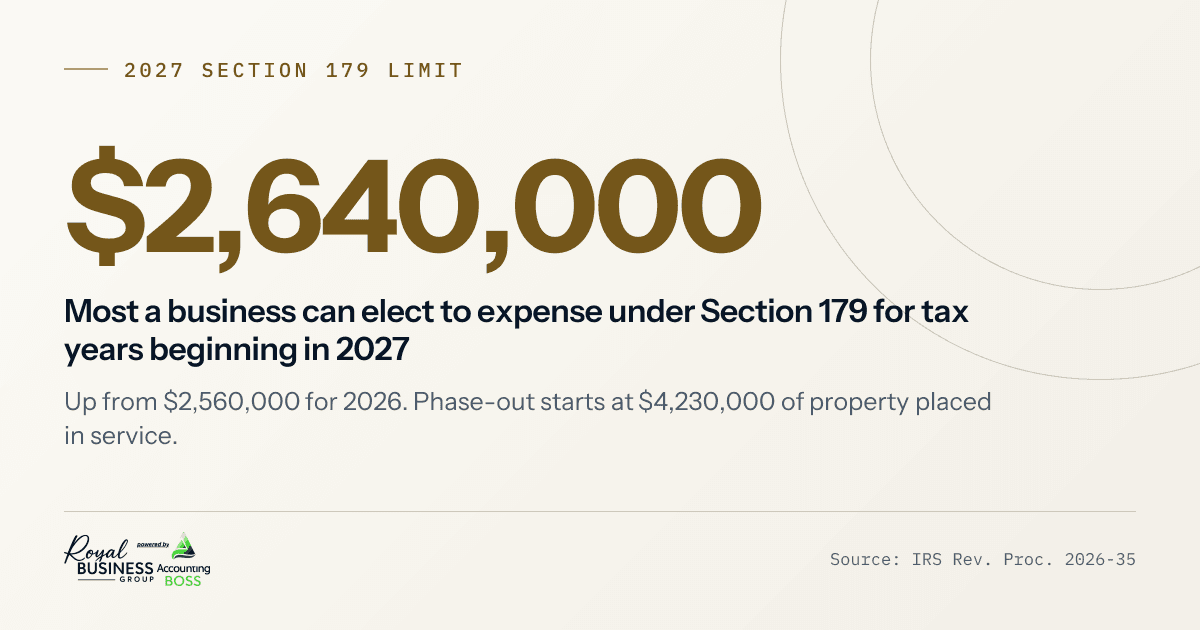
- The Section 179 limit for tax years beginning in 2027 is $2,640,000, up from $2,560,000 for 2026, and it starts to shrink once more than $4,230,000 of Section 179 property is placed in service during the year.
- The 2027 QBI deduction threshold is $416,600 of taxable income for married couples filing jointly and $208,300 for most other filers, up from $403,500 and $201,750 for 2026.
- For plan years beginning in 2027, an employee can put up to $3,500 into a health FSA by salary reduction, and the 2027 monthly limit for transit and for qualified parking is $350 each.
- The 2027 QSEHRA limits are $6,700 for self-only coverage and $13,550 for family coverage, up from $6,450 and $13,100 for 2026.
The IRS has set the 2027 tax inflation adjustments, and the business-side numbers all moved up. For tax years beginning in 2027, the Section 179 limit is $2,640,000, the QBI deduction threshold is $416,600 for a joint return, and an employee can put $3,500 into a health FSA. None of it touches the 2026 return you file in spring 2027, but the employee benefit limits need to be right in your payroll and plan documents before the 2027 plan year and the first January payroll.
The IRS announced the figures on November 5, 2026, and the detail for almost 70 provisions is in Revenue Procedure 2026-35. This is final guidance, not a proposal. Most coverage stopped at brackets and the standard deduction, so here are the numbers a business uses.
The 2027 business figures next to 2026
The 2026 column comes from last year's Revenue Procedure 2025-32 and from IRS Publication 15-B, the fringe benefit guide for employers. All of these are federal figures.
| Item | 2026 | 2027 |
|---|---|---|
| Section 179 maximum | $2,560,000 | $2,640,000 |
| Section 179 phase-out begins at | $4,090,000 | $4,230,000 |
| Section 179 cap for a sport utility vehicle | $32,000 | $33,100 |
| QBI threshold, married filing jointly | $403,500 | $416,600 |
| QBI threshold, all other returns | $201,750 | $208,300 |
| QBI top of phase-in range, married filing jointly | $553,500 | $566,600 |
| QBI top of phase-in range, all other returns | $276,750 | $283,300 |
| Health FSA salary reduction limit | $3,400 | $3,500 |
| Health FSA maximum carryover | $680 | $700 |
| Transit passes and commuter vehicle, per month | $340 | $350 |
| Qualified parking, per month | $340 | $350 |
| QSEHRA, self-only coverage | $6,450 | $6,700 |
| QSEHRA, family coverage | $13,100 | $13,550 |
| Employer educational assistance | $5,250 | $5,400 |
| Cash-method gross receipts test | $32,000,000 | $33,000,000 |
| Excess business loss threshold (joint return) | $256,000 ($512,000) | $264,000 ($528,000) |
"All other returns" in the QBI rows leaves out married people filing separately, whose threshold is $208,325 for 2027 and $201,775 for 2026.
What is the Section 179 limit for 2027?
It is $2,640,000 for tax years beginning in 2027, which is $80,000 more than the $2,560,000 limit for 2026. Section 179 lets a business elect to deduct the cost of qualifying equipment in the year it goes into use instead of spreading the cost over several years.
The limit shrinks dollar for dollar once the Section 179 property a business places in service during its 2027 tax year passes $4,230,000. A business that places $4,500,000 in service is $4,500,000 − $4,230,000 = $270,000 over, so its limit is $2,640,000 − $270,000 = $2,370,000. The limit reaches zero at $2,640,000 + $4,230,000 = $6,870,000. That last figure is our arithmetic, not a number the IRS prints.
If you are weighing an equipment purchase in December 2026 against early 2027, the rule that decides the year is when the property is placed in service, not when you order it or pay for it. Both years' limits are in the table above. For a sport utility vehicle the Section 179 amount is capped separately, at $33,100 for 2027. The Section 179 and bonus depreciation guide explains which property and which vehicles qualify.
What is the QBI deduction income threshold for 2027?
For tax years beginning in 2027 the threshold is $416,600 of taxable income on a joint return and $208,300 on most other returns. Those are up $13,100 and $6,550 from 2026.
The QBI deduction, short for qualified business income, is a deduction for owners of pass-through businesses such as sole proprietorships, partnerships and S corporations. The threshold is the taxable income level where limits on the deduction start to phase in. The second figure, $566,600 joint or $283,300 for most others, is the income level where that phase-in range ends, not the width of the range. An owner whose 2027 taxable income would have landed just above the 2026 threshold now has more room. The QBI deduction guide covers what the limits are and who they hit.
Which employee benefit limits change in January 2027?
Four that small employers commonly offer: the health FSA, commuter and parking benefits, the QSEHRA and educational assistance. These are the ones to act on now, because 2027 elections and payroll settings are being made before the year starts.
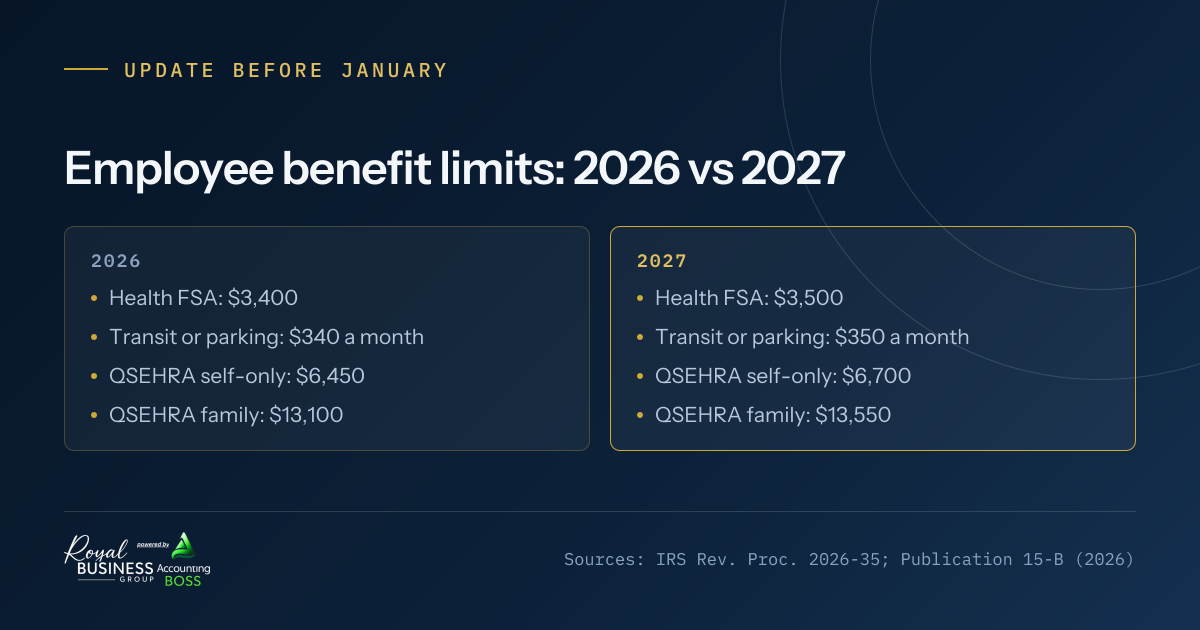
- Health FSA. For plan years beginning in 2027, an employee can contribute up to $3,500 by salary reduction. If your plan allows unused money to carry over, the most that can carry over is $700. Carryover is a plan choice, not an automatic right.
- Commuter and parking. In 2027 an employee can receive up to $350 a month in transit passes and commuter highway vehicle rides combined, and a separate $350 a month in qualified parking, without it counting as income.
- QSEHRA. A qualified small employer health reimbursement arrangement lets a small employer with no group health plan reimburse employees for health costs. For 2027 the yearly cap is $6,700 for self-only coverage and $13,550 for family coverage, up $250 and $450.
- Educational assistance. Up to $5,400 can be excluded from an employee's income for tax years beginning in 2027. Publication 15-B notes that Public Law 119-21 made the exclusion for employer payments of student loans permanent.
One exception matters to owners. Publication 15-B treats an S corporation shareholder who owns more than 2% differently from an ordinary employee for fringe benefits, so check whether you personally qualify before putting yourself in the plan.
Do the 2027 numbers affect the return you file in spring 2027?
No. The return due in spring 2027 is for tax year 2026 and uses the 2026 column. The IRS says the 2027 adjustments generally apply to returns filed in 2028.
Penalty amounts work on a different clock: they follow the year a return is due, not the tax year it covers.
| Penalty figure | Returns due in 2027 | Returns due in 2028 |
|---|---|---|
| Base amount for a late partnership or S corporation return | $260 | $265 |
| Minimum penalty for an income tax return more than 60 days late | $535 | $555 |
The minimum penalty is the lesser of the dollar amount or 100% of the tax due. Penalties for late or incorrect Forms 1099 and W-2 also rise for forms due in 2028. Forms due in early 2027 use the current amounts, which are in the 1099 year-end checklist.
What else moved for 2027?
Two figures matter to fewer businesses. A corporation or partnership meets the gross receipts test for using the cash method of accounting if its average annual gross receipts for the three prior tax years do not exceed $33,000,000, up from $32,000,000. And the threshold in the rule that limits how much business loss a non-corporate owner can use in one year rises to $264,000, or $528,000 on a joint return.
If business income lands on your personal return, the 2027 standard deduction for a married couple filing jointly is $33,200, up $1,000 from 2026.
Retirement plan limits and the Social Security wage base come from separate announcements. Those are in the posts on 2027 401(k) contribution limits and the 2027 Social Security wage base.
What to check before January
- Confirm with your payroll provider and benefits administrator that the $350 commuter and parking limit is loaded for January, and the $3,500 health FSA limit for the plan year that begins in 2027.
- If you offer a QSEHRA or tuition assistance, update the plan amounts you communicate to employees.
- If equipment is arriving around year-end, note the date it will actually be in service.
- Keep using 2026 figures for the return due in spring 2027.
The deadline generator builds a filing calendar from your entity type and state. If you want the new thresholds worked into a 2027 plan for your business, Royal Business Group's tax services team can help, and you can book a free 30-minute consultation.
Sources
Every figure and date above was checked against these before publishing.
This is general information, not tax advice for your situation, and reading it does not make you a client. Rules and figures change — verify anything time-sensitive before you act on it. We'll talk it through with you free.
Common questions
A QSEHRA, or qualified small employer health reimbursement arrangement, is limited to smaller employers. Under IRS Publication 15-B (2026), the employer must not be an applicable large employer, which generally means one that had at least 50 full-time employees, counting full-time equivalents, in the prior calendar year. The employer also must not offer a group health plan to any employee.
Revenue Procedure 2026-35 applies to taxable years beginning in 2027. A fiscal-year business therefore uses the 2027 figures for its tax year that begins in 2027, and keeps using the 2026 figures for a year that began in 2026, even though part of that year falls in 2027.
Under IRS Publication 15-B (2026), qualified parking is parking an employer provides on or near its business premises, or near the place employees commute from by mass transit, commuter highway vehicle or carpool. Parking at or near the employee's home does not count.
Yes. The IRS says the maximum employer-provided childcare credit for tax year 2027 is $515,943.67, up from $500,000 for 2026. The 2027 maximum is $619,132.40 if the employer is an eligible small business.
Revenue Procedure 2026-35 is final IRS guidance, not a proposal. The revenue procedure itself notes that if Congress amends the tax code for 2027 after its release, taxpayers should check later guidance to see whether the adjustments still apply.