Key takeaways
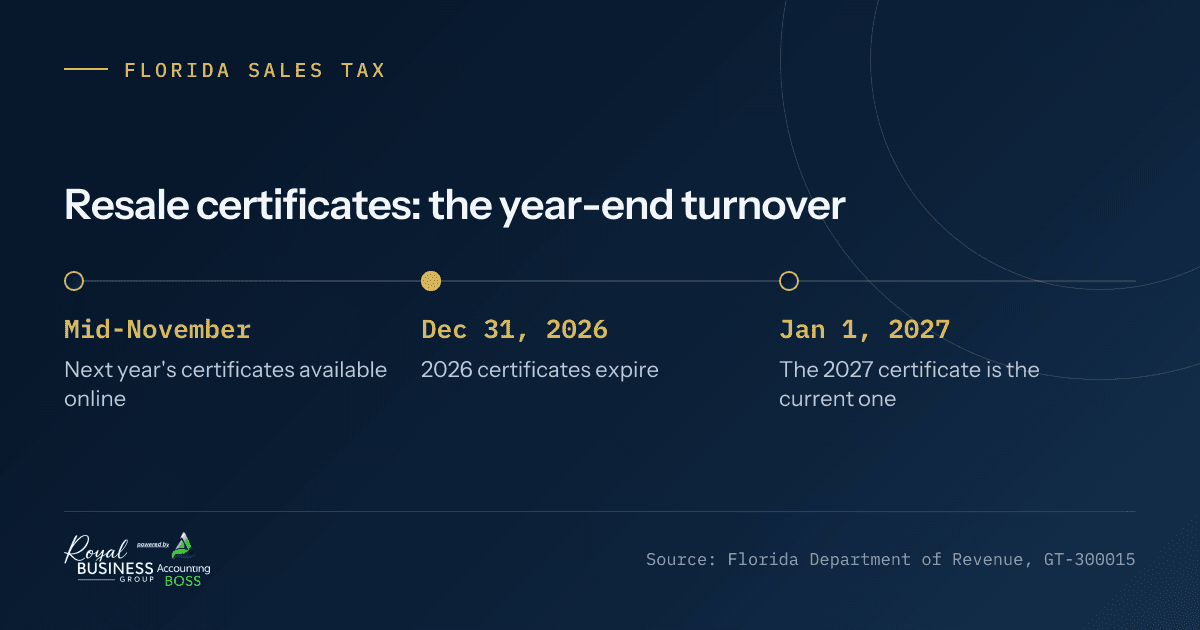
- Florida Annual Resale Certificates for Sales Tax (Form DR-13) expire on December 31 of each year, so a 2026 certificate expires on Thursday, December 31, 2026.
- Florida makes next year's annual resale certificates available online each November, and a dealer that files sales tax returns electronically must log in and print its own; it is not mailed.
- A Florida annual resale certificate covers only items that will be resold or re-rented; a dealer that buys an item tax-free for resale and then uses it in the business owes Florida use tax on it.
- A Florida seller must document each tax-exempt sale for resale with a copy of the customer's current annual resale certificate, a transaction authorization number, or an annual vendor authorization number.
- Under section 212.07 of the Florida Statutes, a dealer who makes a sale for resale without the required documentation is liable for the sales tax on that sale.
Every Florida annual resale certificate expires on December 31, and the one for next year is not mailed to you if you file your sales tax returns online. You log in to the Florida Department of Revenue's site and print it yourself. If you also sell to other businesses tax-free for resale, the same turnover applies to their certificates, and you are the one who owes the tax when such a sale is not documented.
That makes this a two-sided job for the last weeks of the year: get your own 2027 certificate, and decide how you will document each wholesale customer before January.
When does a Florida annual resale certificate expire?
On December 31 of the year printed on it. The Department's sales and use tax page states that certificates expire on December 31 of each year, so a 2026 certificate expires on Thursday, December 31, 2026.
The certificate is Form DR-13, the Florida Annual Resale Certificate for Sales Tax. It is issued to businesses that register with the Department to collect sales tax, and it lets them buy or rent property or services tax-free when those will be resold or re-rented. As long as you keep doing business in Florida and stay registered to collect sales tax, the Department issues you a new certificate each year.
How do you get the 2027 certificate?
It depends on how you file your sales tax returns. The Department's Business Owner's Guide says certificates for the next calendar year are available online in mid-November, behind a login.
| Your situation | How the new certificate reaches you |
|---|---|
| You file sales tax returns electronically | Not mailed. You download and print your own. |
| You file paper returns | Mailed with your annual coupon book or paper return. |
| You are registered for use tax only | You do not receive a resale certificate. |
To print it, go to the Department's Print Annual Resale Certificates page, log in to your sales and use tax account, and select "Print Annual Resale Certificate" from the Choose Activity menu. The same page has a separate button for the communications services tax resale certificate. That is a different certificate.
A supplier that documents your purchases with a copy of your certificate needs the current one on file. Printing the 2027 certificate once it is available and sending a copy to each vendor you buy inventory from puts it in their files before your first January order.
What can you buy tax-free with it, and what can you not?
Only things you will resell or re-rent in the regular course of business. That includes items that become a component part of a product you sell. The Department's example is the nails, fabric and wood that go into a chair.
The certificate does not cover anything the business uses itself, such as furniture, office equipment, computers or supplies, and it does not cover personal purchases. It is a way to move the tax to the final sale, not a tax exemption for the business.
Plans change, and the rule accounts for that. If you buy an item tax-free for resale and then use it in the business or personally, you report and pay use tax on it on your sales and use tax return. Use tax is calculated at the same rate as sales tax, and Florida's general state rate is 6%. Under section 212.05 of the Florida Statutes, that 6% applies to the cost price of an item that is used instead of sold.
A worked example: an office furniture store buys ten desks from a wholesaler at $400 each, tax-free on its resale certificate. Nine go on the showroom floor. The owner keeps one for the back office.
- Purchase price of the desk kept for the business: $400
- Florida use tax at the 6% general state rate: $400 × 0.06 = $24
The store reports that $24 on its sales and use tax return. Many counties add a discretionary sales surtax at a rate that varies by county, and where one applies it is due on top.
Honest mistakes are fixed that way. Fraud is different: under section 212.085 of the Florida Statutes, a person who fraudulently presents an exemption certificate to evade the tax is liable for the tax plus a mandatory penalty of 200 percent of the tax, and the offense is a third-degree felony.
How do you document a customer's tax-free purchase for resale?
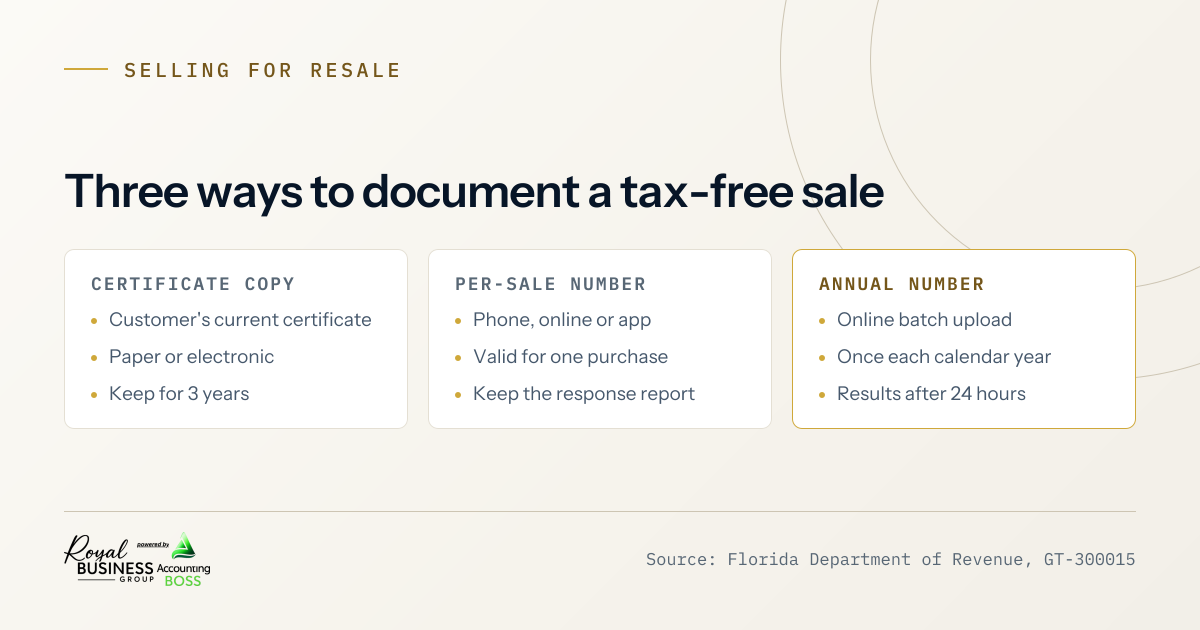
Florida accepts three methods, and you can use a different one for different sales. Whichever you choose, the documentation has to exist. Section 212.07 of the Florida Statutes makes the selling dealer liable for the tax on a sale for resale that does not meet the registration statute and the Department's rules.
| Method | How you get it | What it covers | What you keep |
|---|---|---|---|
| Copy of the customer's current certificate | From the customer, on paper or electronically | Sales while that certificate is current | The copy |
| Transaction authorization number | By phone at 877-FL-RESALE (877-357-3725), online, or in the Department's FL Tax-Verify mobile app, using the customer's certificate number | That one purchase only | The verification response report |
| Annual vendor authorization number | Online, by uploading a batch file of customer certificate numbers; results are ready 24 hours after submission | That customer for the calendar year | The results file you retrieve and save |
The online route for both kinds of number is the Department's Seller Certificate Verification site. It either issues a number or tells you the purchaser does not hold a valid certificate, which is worth knowing before the goods leave.
If you hold a transaction or vendor authorization number, you do not also need a copy of the customer's certificate. Either way, Florida sales and use tax records, including certificates you accepted and authorization numbers, must be kept for at least three years from the date the return was filed or was required to be filed, whichever is later.
For a business with a handful of wholesale customers, collecting each one's new certificate is the simplest. For a distributor with hundreds, the annual batch upload does the whole list at once.
Do you need a new certificate from every customer each year?
The methods the Department describes all work that way: a current certificate, a number for each sale, or a number for each calendar year.
The statute does contain a narrower exception. Under section 212.07, a seller may rely on a certificate that was valid when the customer provided it, without verifying it again each year, when the seller makes recurring sales to that customer in the normal course of business on a continual basis. Both terms are defined. Recurring sales are sales on credit recorded as an account receivable, or sales to a customer with an established cash or C.O.D. account similar to an open credit account. A continual basis means at least one sale to that customer in every 12-month period.
A walk-in buyer, or an account that goes quiet for more than a year, falls outside it. The Department's guide does not mention the exception, and its web page touches on it only in a FAQ answer about on-account customers, which is a good reason to treat the annual refresh as the standard practice and the exception as a backstop.
A short list for the next few weeks
- Print your own 2027 certificate once it is available, and check that the business name on it is right.
- Send it to your suppliers before your first January order.
- List every customer you sell to tax-free and pick a documentation method for each.
- Request new certificates or run the batch upload so the 2027 documentation is in your files when the first 2027 invoice goes out.
- Look for inventory you pulled for your own use during 2026 and make sure use tax was reported on it.
It sits naturally alongside the other year-end paperwork, such as the 1099 year-end checklist for contractor payments.
Florida sales tax calculation and filing are part of Royal Business Group's tax services, and you can book a free 30-minute consultation to talk through how your resale documentation and sales tax filings line up.
Sources
Every figure and date above was checked against these before publishing.
- Annual Resale Certificate for Sales Tax — Florida Department of Revenue
- Business Owner's Guide for the Major Florida Taxes (GT-300015, R. 11/25) — Florida Department of Revenue
- Florida Sales and Use Tax — Florida Department of Revenue
- Print Annual Resale Certificates — Florida Department of Revenue
- Seller Certificate Verification — Florida Department of Revenue
- Section 212.05, Florida Statutes (2026): Sales, storage, use tax; rate applied to cost price of items used — Florida Legislature
- Section 212.07, Florida Statutes (2026): Sales, storage, use tax; dealer liability and documentation of sales for resale — Florida Legislature
- Section 212.085, Florida Statutes (2026): Fraudulent claim of exemption; penalties — Florida Legislature
This is general information, not tax advice for your situation, and reading it does not make you a client. Rules and figures change — verify anything time-sensitive before you act on it. We'll talk it through with you free.
Common questions
No. The Florida Department of Revenue says signatures are no longer required on an Annual Resale Certificate for Sales Tax. What the certificate does need is the proper business name, and it has to be current.
No. The Florida Department of Revenue says the address on an annual resale certificate does not have to match the buyer's location, as long as the certificate shows the proper business name and is current. A certificate that shows only the owner's name and not the d/b/a name can also be accepted.
No. A business registered with the Florida Department of Revenue only to pay use tax does not receive an annual resale certificate, because it cannot make tax-exempt purchases for resale. The certificate goes to businesses registered to collect sales tax.
Possibly not. The Florida Department of Revenue says certificates issued to new business locations beginning in mid-October are effective from the date they are issued through the following calendar year. The Department's page does not give an exact cut-off date, so the expiration date printed on the certificate is the thing to check.
No. The Florida Department of Revenue says a vendor does not have to get a certificate from the purchaser for sales of items that are specifically exempt by law, although the invoice should identify the exempt items. An item that is exempt only because of how the buyer will use it calls for an exemption certificate, which is a different document from a resale certificate.