

Key takeaways
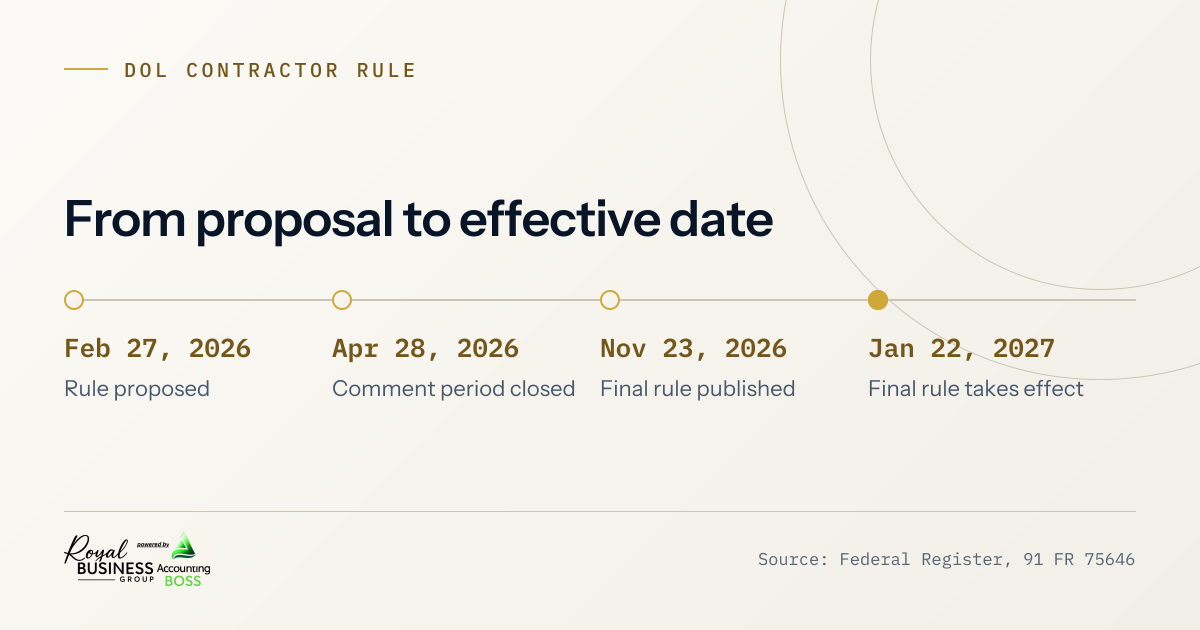
- The Department of Labor's final independent contractor rule was published in the Federal Register on November 23, 2026 (91 FR 75646) and takes effect on Friday, January 22, 2027.
- The DOL independent contractor rule gives the most weight to two core factors: the nature and degree of control over the work, and the worker's opportunity for profit or loss.
- Under the DOL rule, two core factors pointing the same way make that classification substantially likely, but the rule lists five factors and says no single factor decides the question.
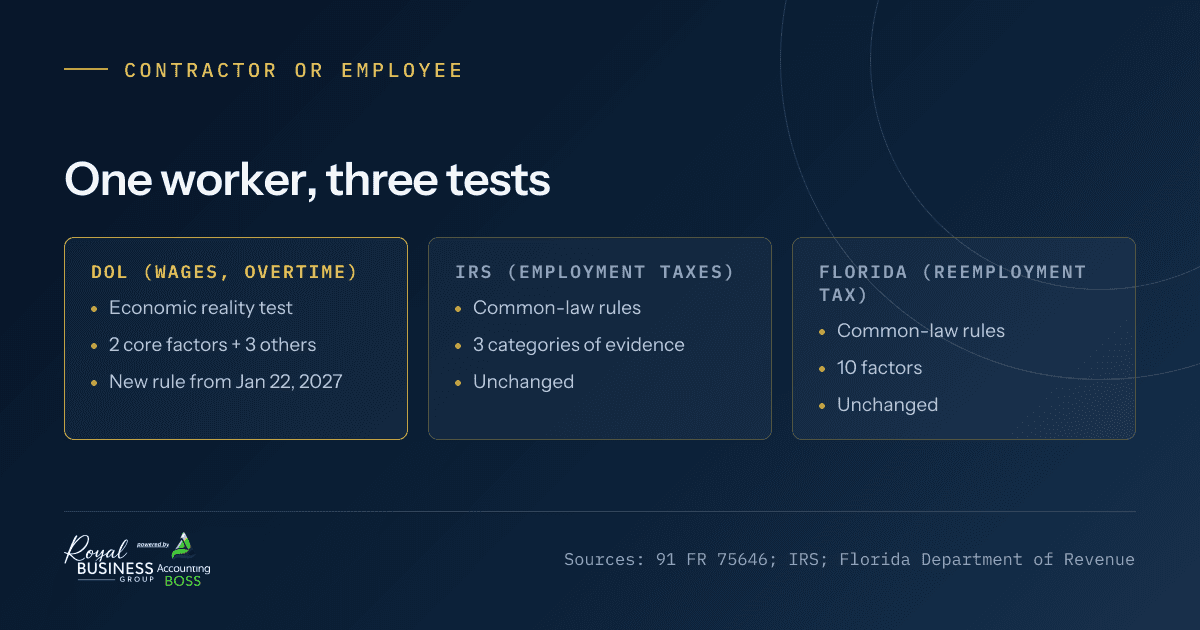
- The DOL rule does not change the IRS common-law test for federal employment taxes or Florida's 10-factor test for reemployment tax, so a worker at a Florida business is still tested three separate ways.
- Under the DOL rule, what actually happens in a working relationship counts for more than what the independent contractor agreement says.
The Department of Labor published its final rule on who counts as an independent contractor on Monday, November 23, 2026, and it takes effect on Friday, January 22, 2027. The DOL independent contractor rule changes the federal wage-and-hour test by giving the most weight to two factors: who controls the work, and whether the worker can make or lose money through their own decisions. It does not change the IRS test for employment taxes or Florida's test for reemployment tax, so a worker at a Florida business still has to pass three separate tests.
That last point is the one owners tend to miss. A worker can be a contractor under one test and an employee under another.
When does the DOL independent contractor rule take effect?
On Friday, January 22, 2027, which is 60 days after it was published. This is a final rule in the Federal Register (91 FR 75646), not a proposal, but until that date it is published and not yet in force.
The rule sets out how the Department's Wage and Hour Division decides whether a worker is an employee under the Fair Labor Standards Act (FLSA), the federal law behind minimum wage and overtime. The distinction matters because the FLSA does not require a business to pay an independent contractor minimum wage or overtime, or to keep FLSA records on that contractor. Those obligations apply to employees.
It withdraws the analysis the Department adopted in 2024, a six-factor test in which no factor had preset extra weight, and replaces it with one similar to the Department's 2021 rule, with modifications. The Wage and Hour Division had already stopped applying the 2024 analysis in its own enforcement on May 1, 2025, so the final rule formalises a shift that began earlier.
What are the two core factors in the DOL test?
They are the nature and degree of control over the work, and the worker's opportunity for profit or loss. The rule says each of these typically carries more weight than any other factor.
Both serve one underlying question, which the rule calls economic dependence: does the worker depend on your business for work, or is the worker in business for himself or herself?
| Core factor | Points toward employee | Points toward contractor |
|---|---|---|
| Control over the work | The business controls the schedule or workload, or requires the worker to work only for it | The worker sets their own schedule, chooses their projects, or can work for others, including competitors |
| Opportunity for profit or loss | The worker can earn more only by working more hours or working faster | Earnings depend on the worker's own initiative or investment, such as helpers, equipment or materials |
When both core factors point the same way, the rule says there is a "substantial likelihood" that the classification is right. That is a strong indication, not an automatic result. Three other factors are listed with less weight: the amount of skill the work requires, how permanent the relationship is, and whether the work is part of an integrated unit of production. The rule says the factors are not exhaustive and no single one decides the question.
There is an exception inside the control factor that matters to most businesses that hire trades. Requiring a worker to follow the law, meet health and safety standards, carry insurance, or meet agreed deadlines and quality standards does not count as control. The label does not settle it, though. Detailed instructions on how, when or where to do the work can still show employment, even when they are described as safety or quality control.
Does a signed contractor agreement settle it?
No. Under the rule, what the parties actually do is more relevant than what the contract says is possible. A right the worker has on paper but cannot use in practice counts for little. So does a right to supervise that the business never uses.
The rule comes with 14 worked examples, and two of them correct common assumptions:
- A second income does not make someone a contractor. Economic dependence is not about how much the worker earns or whether they have other income. In the rule's example, a full-time, hourly-paid home renovation worker who also co-owns a profitable food truck still points toward employee status for the construction work.
- Seasonal work does not make someone a contractor. A housekeeper who returns to the same resort every winter has an indefinite relationship, which points toward employee status.
A worker who is an employee under the FLSA also cannot sign those rights away by agreeing to be called a contractor.
Does the DOL rule change the IRS or Florida test?
No. The Department's FAQ on the final rule says it only revises the analysis under the FLSA and two other federal labor laws, and has no effect on laws that use different classification standards.
| Who is asking | What it decides | The test | Changed by this rule? |
|---|---|---|---|
| Department of Labor | Minimum wage, overtime and FLSA records | Economic reality: 2 core factors and 3 others | Yes, from January 22, 2027 |
| IRS | Federal employment taxes | Common-law rules in 3 categories: behavioral, financial, type of relationship | No |
| Florida Department of Revenue | Reemployment tax | Common-law rules, described through 10 factors | No |
The IRS says no set number of factors makes a worker an employee or a contractor, and a business that treats an employee as a contractor with no reasonable basis may be held liable for employment taxes for that worker. Our guide to 1099 versus W-2 classification covers the IRS test in detail.
For Florida reemployment tax, the Florida Department of Revenue says status turns on how the worker is treated, not on the wording of an agreement or the fact that a 1099 was issued. It also says intentional misclassification is a felony.
What to look at before January 22
The rule arrives while many owners are already totalling contractor payments for year-end 1099 forms, which makes this a practical time to look at each contractor relationship. These are the questions the rule asks, applied to what actually happens and not to what the agreement says:
- Who sets the schedule and the workload?
- Can the worker take other clients, including your competitors?
- Can the worker raise their earnings by their own decisions, such as bringing helpers or investing in equipment and materials, or only by working more hours or faster?
- Does the contract describe the relationship as it really runs?
Then run the IRS and Florida tests separately, because an answer under one does not carry over to the others.
Royal Business Group runs payroll and payroll tax filing for small businesses as part of its bookkeeping and accounting service. If you want to talk through how you pay the people who work for you before the rule takes effect, you can book a free 30-minute consultation.
Sources
Every figure and date above was checked against these before publishing.
- Employee or Independent Contractor Status Under the Fair Labor Standards Act, Family and Medical Leave Act, and Migrant and Seasonal Agricultural Worker Protection Act; Final Rule, 91 FR 75646 — Federal Register (Government Publishing Office)
- Frequently Asked Questions (FAQs) for the 2026 Employee or Independent Contractor Final Rule — U.S. Department of Labor
- Independent contractor (self-employed) or employee? — IRS
- Classification of Workers for Reemployment Tax - Employees vs. Independent Contractors — Florida Department of Revenue
This is general information, not tax advice for your situation, and reading it does not make you a client. Rules and figures change — verify anything time-sensitive before you act on it. We'll talk it through with you free.
Common questions
The rule does not make a change of label lawful by itself. Under the rule, the facts of the working relationship decide a worker's status, and actual practice counts for more than the contract. The IRS test for employment taxes and Florida's test for reemployment tax are not changed by the rule, so a worker would still have to qualify as a contractor under each of those separately.
The final rule withdraws the 2024 analysis as of January 22, 2027 and replaces it with one similar to the Department's 2021 rule, with modifications. The 2024 rule used a six-factor test in which no factor had preset extra weight. The Wage and Hour Division had already stopped applying the 2024 analysis in its own enforcement on May 1, 2025.
Yes. The Department of Labor will use the same analysis to decide employee or contractor status under the Family and Medical Leave Act and the Migrant and Seasonal Agricultural Worker Protection Act. The Department's FAQ says the rule has no effect on other laws that use different classification standards.
For tax purposes, yes. A business or a worker can file Form SS-8 and the IRS will determine the worker's status for federal employment taxes and income tax withholding. The IRS says a determination may take at least six months, and it does not decide the worker's status under the federal wage-and-hour law.
No. The Department of Labor says in the final rule that it does not override state law, and that states and localities can apply stricter tests for who is a contractor. A business has to meet the state test that applies to it as well as the federal one.