Key takeaways
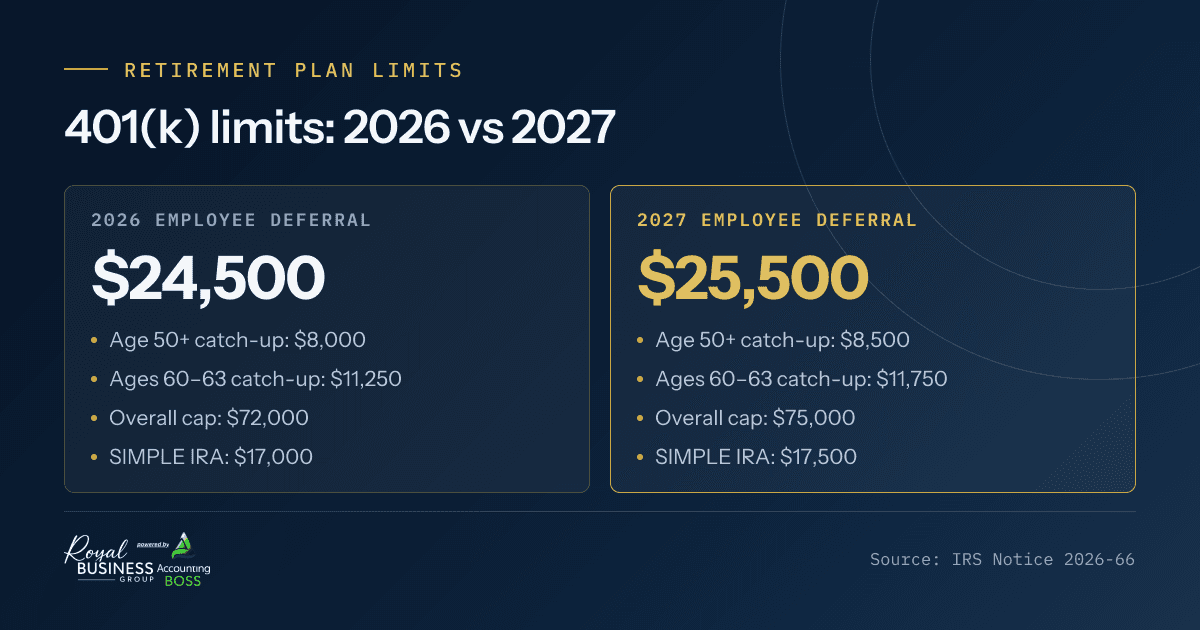
- The 2027 401(k) employee contribution limit is $25,500, up from $24,500 for 2026, under figures the IRS announced on November 12, 2026 in Notice 2026-66.
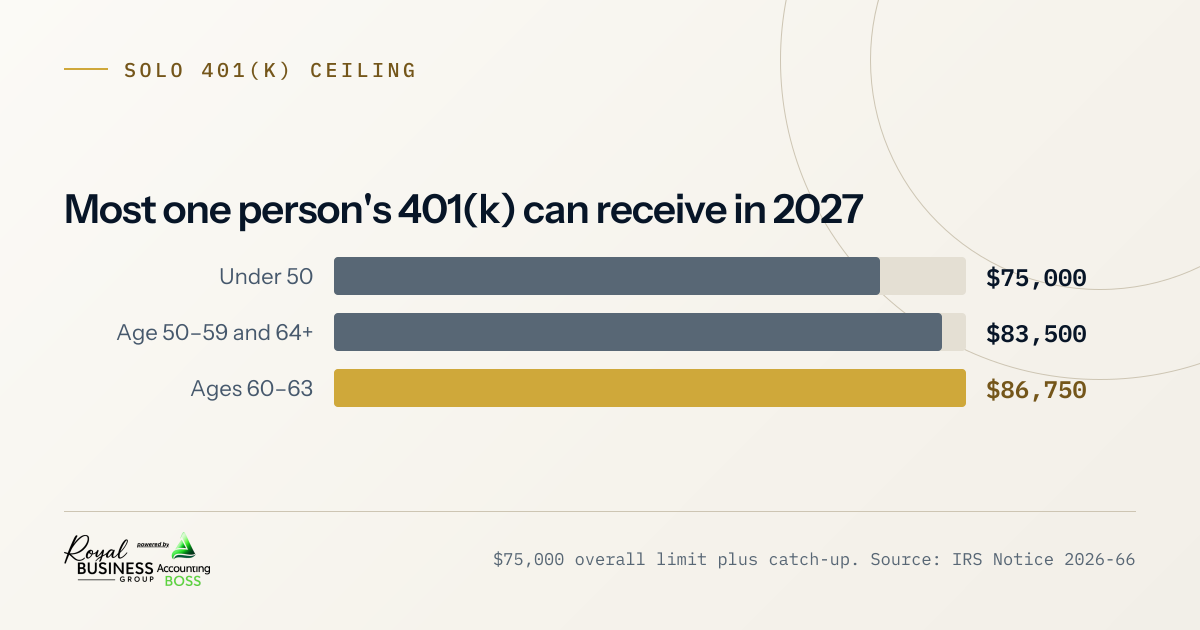
- The 2027 overall limit on contributions to a solo 401(k) or a SEP-IRA is $75,000, up from $72,000 for 2026, and 401(k) catch-up contributions sit on top of that limit.
- The 2027 401(k) catch-up contribution limit is $8,500 for people aged 50 and over, or $11,750 instead of $8,500 for people who turn 60, 61, 62 or 63 during 2027.
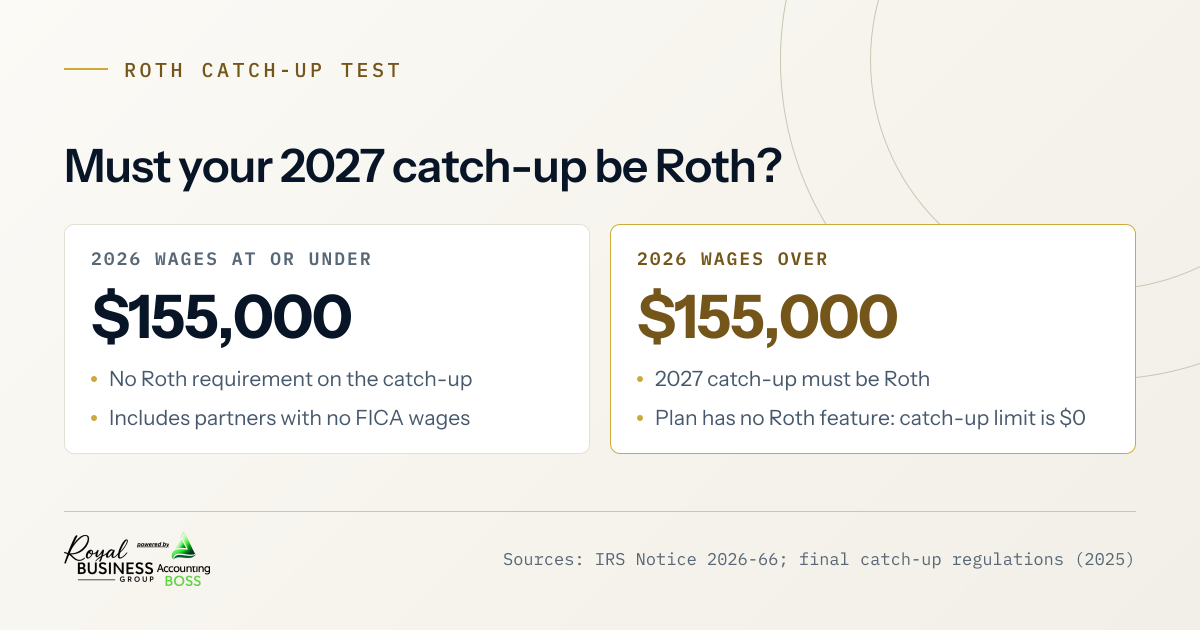
- A 401(k) participant whose 2026 wages from the employer sponsoring the plan exceeded $155,000 must make 2027 catch-up contributions as Roth, and can make none if the plan has no Roth feature.
- The 2027 SIMPLE IRA employee contribution limit is generally $17,500, up from $17,000 for 2026, and $19,100 for SIMPLE plans of employers with 25 or fewer employees; the IRA contribution limit stays at $7,500.
The 2027 401(k) contribution limit is $25,500, up $1,000 from 2026. The IRS announced it on Thursday, November 12, 2026 in news release IR-2026-136, and the figures are final, not projections. For an owner, the more useful numbers are in the technical notice behind the release, Notice 2026-66: the overall cap that governs a solo 401(k) and a SEP-IRA rises to $75,000, and the wage test that forces catch-up contributions into Roth moves to $155,000.
What is the 401(k) contribution limit for 2027?
For 2027 an employee can defer up to $25,500 of pay into a 401(k), against $24,500 for 2026.
| Limit | 2026 | 2027 |
|---|---|---|
| 401(k) employee deferral | $24,500 | $25,500 |
| 401(k) catch-up, age 50 and over | $8,000 | $8,500 |
| 401(k) catch-up, ages 60 to 63 | $11,250 | $11,750 |
| Overall limit, employee plus employer | $72,000 | $75,000 |
| Pay that can be counted (compensation cap) | $360,000 | $375,000 |
| SIMPLE IRA employee contribution | $17,000 | $17,500 |
| SIMPLE IRA higher employee limit | $18,100 | $19,100 |
| SIMPLE catch-up, age 50 and over (most plans) | $4,000 | $4,000 |
| SIMPLE catch-up, ages 60 to 63 | $5,250 | $5,250 |
| IRA contribution | $7,500 | $7,500 |
A catch-up contribution is the extra deferral allowed for older savers. You qualify if you are 50 or over at the end of the calendar year. The higher tier is for people who turn 60, 61, 62 or 63 during 2027, and it replaces the $8,500. It is not added to it. So the most an employee can defer in 2027 is $34,000 at 50 or over ($25,500 + $8,500), or $37,250 at ages 60 to 63 ($25,500 + $11,750).
How much can go into a solo 401(k) in 2027?
Up to $75,000 if you are under 50, $83,500 with the age-50 catch-up, and $86,750 with the catch-up for ages 60 to 63. Those totals are the $75,000 overall limit plus the catch-up, because catch-up contributions do not count toward the overall limit.
These are ceilings, not entitlements. In a solo 401(k) you contribute twice: as the employee, up to the $25,500 deferral limit, and as the employer, up to 25% of compensation as the plan defines it.
Worked example. You are 52 and your S-corp pays you a $120,000 W-2 wage in 2027:
- Employee deferral: $25,500
- Catch-up: $8,500
- Employer contribution: 25% × $120,000 = $30,000
- Total: $64,000
On the 2026 limits the same wage reaches $62,500. To hit the full $75,000 under age 50, a W-2 owner needs $198,000 of wages: ($75,000 − $25,500) ÷ 0.25. The employer piece is a percentage of your wage, so the salary you set also sets your retirement room. Keep that in view when you run the S-corp savings calculator.
Sole proprietors and partners do not use a flat 25%. The IRS requires a special computation based on earned income. Our solo 401(k) vs SEP-IRA guide walks through that formula, how the two plans compare, and the setup deadlines.
The deferral limit is also per person, not per plan. A 401(k) at a day job and your own solo 401(k) share one $25,500.
What are the SEP-IRA and SIMPLE IRA limits for 2027?
A SEP-IRA can receive the lesser of 25% of compensation or $75,000 for 2027. The SIMPLE IRA employee limit is generally $17,500, or $19,100 at employers with 25 or fewer employees.
SEP-IRA. Only the employer contributes. Salary deferrals and catch-up contributions are not allowed. The dollar cap is the same overall limit set in Notice 2026-66: $75,000 for 2027, up from $72,000. On a flat 25% of W-2 wages it takes $300,000 of pay to get there ($75,000 ÷ 0.25), against $198,000 in a solo 401(k). A SEP can be set up and funded as late as the due date of the business's income tax return, including extensions.
SIMPLE IRA. The general employee limit is $17,500 for 2027, up from $17,000. A plan of an employer with 25 or fewer employees generally gets a higher limit automatically: $19,100, up from $18,100. The count is of employees paid at least $5,000 in the preceding year. Employers with 26 to 100 employees get it only if they elect it, which the IRS ties to a larger employer contribution (a 4% match or a 3% nonelective contribution). No catch-up amount changed: $4,000 at 50 and over in most plans, $3,850 in plans that use the higher limit, and $5,250 at ages 60 to 63. On the standard limit the most an employee can contribute is $21,500 at 50 and over ($17,500 + $4,000) or $22,750 at ages 60 to 63 ($17,500 + $5,250). In a plan with the higher limit the age-50 maximum is $22,950 ($19,100 + $3,850).
Do catch-up contributions have to be Roth in 2027?
Only if your 2026 wages from the employer that sponsors the plan were more than $155,000. In that case any catch-up contribution you make in 2027 has to be a Roth (after-tax) contribution. The rule is not new. It has applied since 2026, when the test was $150,000 of 2025 wages. Only the threshold changed.
- Whose wages count. The test looks only at FICA wages (Social Security wages) from the employer sponsoring the plan. Under the final catch-up regulations, someone with no FICA wages from that employer in the prior year, such as a partner with only self-employment income, is not subject to the requirement. The same generally holds for a sole proprietor. An S-corp owner paid a W-2 wage by their own corporation does have FICA wages from the plan sponsor and needs to check them against $155,000.
- What it covers. Only the catch-up portion. The regular $25,500 deferral is not affected, and the test does not apply to SEP or SIMPLE IRA plans.
- What happens without a Roth option. If the plan has no Roth feature, a participant over the threshold cannot make catch-up contributions at all. Their catch-up limit under that plan is $0.
What to settle before January 1
The 2026 tax year ends on Thursday, December 31, 2026, and the 2027 limits apply from January 1. That leaves about six weeks for four checks.
- Your 2026 deferrals. Compare year-to-date deferrals with the 2026 limit of $24,500, plus $8,000 or $11,250 if a catch-up applies. Under Publication 560, employees' deferrals must be elected and made by the end of the tax year. A self-employed owner must elect the deferral by year end but can deposit it as late as the tax return filing deadline, including extensions. An S-corp owner's deferral has to be elected by December 31.
- Your January election. If your deferral is a fixed dollar amount per paycheck sized to the 2026 limit, the same election in 2027 stops $1,000 short of the new limit.
- 2026 wages for anyone 50 or over. For each owner-employee or staff member who makes catch-up contributions, compare 2026 wages from the business with $155,000.
- The plan document. Confirm the 401(k) has a Roth feature.
These checks sit alongside the other year-end moves in our small business tax planning guide. If you want the limits worked through against your own payroll and return, that is part of Royal Business Group's tax services, and the first consultation is free.
Sources
Every figure and date above was checked against these before publishing.
- 401(k) limit increases to $25,500 for 2027, IRA limit remains $7,500 (IR-2026-136) — IRS
- Notice 2026-66: 2027 Amounts Relating to Retirement Plans and IRAs, as Adjusted for Changes in Cost-of-Living — IRS
- One-participant 401(k) plans — IRS
- Retirement topics: Catch-up contributions — IRS
- Retirement topics: 401(k) and profit-sharing plan contribution limits — IRS
- SEP contribution limits (including grandfathered SARSEPs) — IRS
- Simplified employee pension plan (SEP) — IRS
- Publication 560 (2025), Retirement Plans for Small Business — IRS
- Catch-Up Contributions, final regulations (FR Doc. 2025-17865, September 16, 2025) — Federal Register
- SIMPLE IRA plan — IRS
- Retirement plans definitions — IRS
This is general information, not tax advice for your situation, and reading it does not make you a client. Rules and figures change — verify anything time-sensitive before you act on it. We'll talk it through with you free.
Common questions
No. The employee deferral limit applies to the person, not to each plan. Deferrals you make to every plan you participate in are added together, so for 2027 a day-job 401(k) and a solo 401(k) share one $25,500 limit.
No. The IRA contribution limit remains $7,500 for 2027, and the IRA catch-up contribution for people aged 50 and over remains $1,100. The income ranges that decide whether an IRA contribution is deductible, and who can contribute to a Roth IRA, did rise for 2027.
The standard one, $8,500. The higher 2027 catch-up of $11,750 is only for people who turn 60, 61, 62 or 63 during 2027. Someone who turns 64 during 2027 goes back to the $8,500 limit that applies to everyone aged 50 and over.
For 2027 the annual compensation limit is $375,000, up from $360,000 for 2026. It is the most pay that can be counted when calculating contributions, including SEP contributions. For a 25% employer contribution the $75,000 overall limit binds first, because 25% of $375,000 is $93,750.
Yes, but the highly compensated employee threshold looks back a year. An employee is generally highly compensated if their pay from the business in the preceding year was above the threshold, so pay above $170,000 in 2027 counts for the 2028 plan year, and the 2027 plan year is tested on 2026 pay above $160,000. An owner of more than 5% of the business is highly compensated regardless of pay. Separately, the officer pay threshold in the definition of a key employee for top-heavy purposes is $245,000 for 2027, up from $235,000.