Key takeaways
- The IRS interest rate on unpaid federal tax rises from 7% to 8% per year, compounded daily, for the quarter from January 1 to March 31, 2027, as announced in IRS news release IR-2026-144.
- The 8% IRS underpayment rate applies to any federal tax balance still unpaid in the first quarter of 2027, including older balances, but interest for earlier quarters stays at those quarters' rates.
- The penalty for underpaying estimated tax in the first quarter of 2027 uses the same 8% annual rate, applied to the shortfall for the time it was unpaid; the penalty is not a flat 8% charge.
- The fourth estimated tax payment for tax year 2026 is due Friday, January 15, 2027; an individual who files the 2026 return and pays the full balance by February 1, 2027 does not have to make it.
- The IRS does not remove or reduce interest for reasonable cause or as first-time relief, and an IRS payment plan does not stop interest from accruing daily on the unpaid balance.
The IRS interest rate on unpaid tax goes up from 7% to 8% a year on January 1, 2027. It applies to any federal tax balance still open on that date, old or new, it compounds daily, and it is also the rate used to price a short or late estimated tax payment. Unlike a penalty, interest is almost never taken off, so the only reliable way to pay less of it is to owe less, sooner.
The IRS announced the increase on November 24, 2026 in news release IR-2026-144. The rates are formally set out in Revenue Ruling 2026-25.
What is the IRS interest rate for the first quarter of 2027?
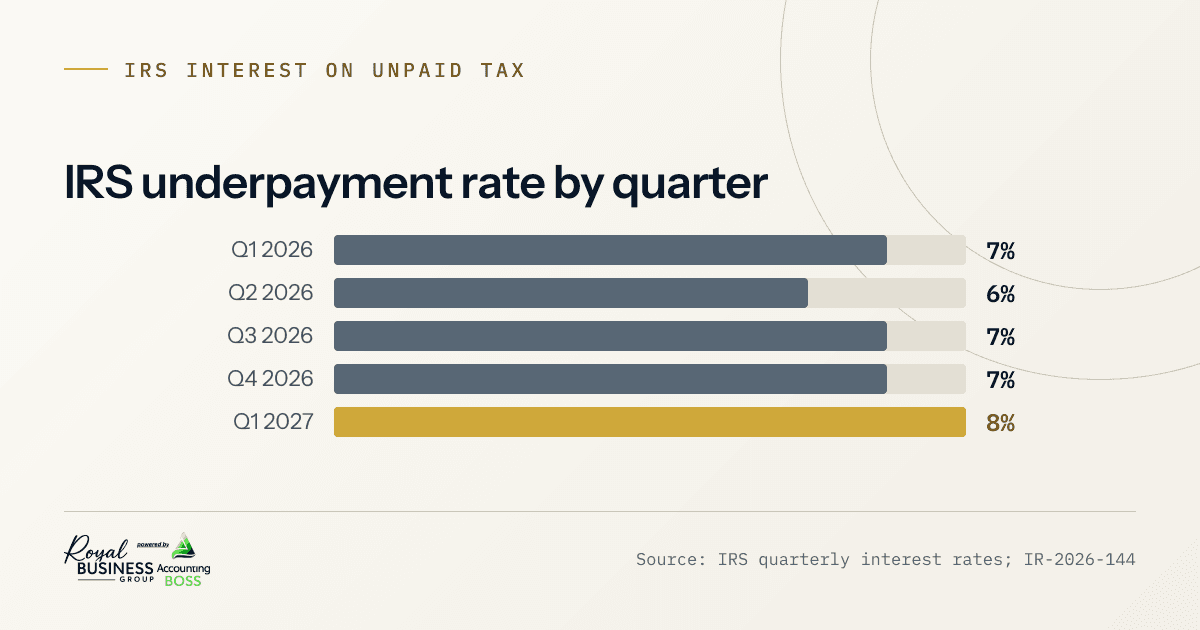
It is 8% per year, compounded daily, for the quarter that runs from January 1 through March 31, 2027. That is one percentage point above the 7% charged for October through December 2026.
The individual rate is the one that covers sole proprietors, partners and S corporation shareholders paying on their own returns. An underpayment is tax owed but not fully paid; an overpayment is what you paid beyond what you owed.
| First quarter of 2027 | Individuals and other non-corporate taxpayers | Corporations |
|---|---|---|
| Rate on unpaid tax (underpayments) | 8% | 8% |
| Rate on overpayments | 8% | 7% |
| Portion of an overpayment over $10,000 | Not applicable | 5.5% |
| Large corporate underpayments | Not applicable | 10% |
The 10% rate is for C corporation underpayments exceeding $100,000, so it rarely touches a small business.
The IRS's quarterly interest rate tables show the underpayment rate at 8% for all of 2024, 7% for all of 2025, and 7%, 6%, 7% and 7% for the four quarters of 2026. By our reading of those tables, the first quarter of 2027 is the first at 8% since the end of 2024.
The rate is reset every quarter by formula. For non-corporate taxpayers it is the federal short-term rate plus 3 percentage points. The short-term rate determined in October 2026 rounds to 5%, and 5% + 3 points = 8%. Only the first quarter has been announced; the rate for April onward is not known yet.
Does the 8% rate apply to tax you already owe?
Yes. The new rate applies to every amount bearing interest during the quarter, including a balance from an earlier year. If it is still unpaid on January 1, 2027, it starts accruing at 8% that day.
The change is not retroactive. The IRS states that a rate change does not affect interest charged for prior quarters or years, so what built up through December 31, 2026 stays at the rates then in force.
Interest is compounded daily, so each day's interest is charged on the previous day's balance plus the interest already added. It accrues on unpaid tax, on penalties and on earlier interest until the balance is paid in full.
What does one extra point cost?
On a round number, a small amount per quarter. This is our own illustration, not an IRS figure; the IRS uses its own published factor tables, so its result can differ slightly.
Take $10,000 left unpaid for the 90 days from January 1 to March 31, 2027. Daily compounding works out as $10,000 × ((1 + rate ÷ 365)^90 − 1).
| Rate | Interest on $10,000 over 90 days |
|---|---|
| 7% (the rate through December 2026) | About $174 |
| 8% (the rate from January 1, 2027) | About $199 |
The difference is about $199 − $174 = $25 for the quarter. The bigger cost is the roughly $199 itself, which sits on top of the failure-to-pay penalty: 0.5% of the unpaid tax for each month or part of a month, up to 25%. The IRS charges interest on that penalty too.
How does the rate affect the estimated tax penalty?
The underpayment rate is the price of a missed or short estimated payment. Revenue Ruling 2026-25 confirms the 8% rate applies to estimated tax underpayments for the first quarter of 2027, for individuals and corporations, and adds that for individuals it also covers the first 15 days of April.
It is not a flat 8% of the shortfall. The IRS figures the penalty from the amount underpaid, the period it stayed underpaid and the published quarterly rate.
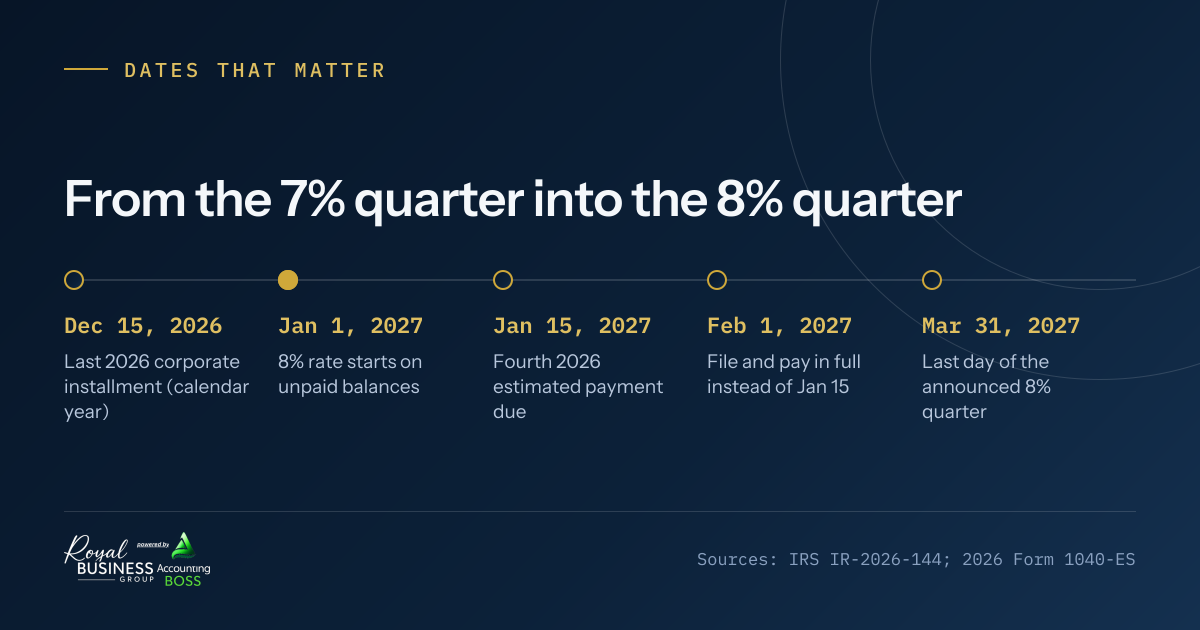
The fourth estimated payment for tax year 2026, covering income from September 1 to December 31, is due Friday, January 15, 2027. The 2026 Form 1040-ES gives one alternative: an individual who files the 2026 return by February 1, 2027 and pays the entire balance with it does not have to make the January 15 payment.
The same form states the general rule for avoiding the penalty for tax year 2026. An individual generally owes none if the balance after withholding and credits is under $1,000, or if payments covered the smaller of 90% of the 2026 tax or 100% of the tax on the 2025 return. If 2025 adjusted gross income was more than $150,000 ($75,000 if married filing separately for 2026), 110% replaces 100%. Different rules apply to farmers and fishers. The form also says the penalty is imposed on each underpayment for the number of days it remains unpaid, so a payment that was late or short can draw a penalty even when the total for the year is enough. The quarterly estimated taxes guide walks through the calculation.
Corporations generally must make estimated payments if they expect to owe $500 or more. Their installments are due by the 15th day of the 4th, 6th, 9th and 12th months of the tax year, which for a calendar-year corporation puts the last 2026 installment on Tuesday, December 15, 2026.
Can IRS interest be waived, and does a payment plan stop it?
No to both, and this is the part people get wrong. The IRS says it does not remove or reduce interest for reasonable cause or as first-time relief. Interest comes down only when the tax or penalty underneath it is reduced, or where it resulted from an unreasonable error or delay by an IRS officer or employee, which is requested on Form 843.
A payment plan does not stop interest either. It keeps accruing daily on whatever is unpaid, so anyone already on a plan will see the remaining balance accrue at 8% from January 1. A plan does cut the penalty: for an individual who filed on time, the failure-to-pay penalty drops from 0.5% to 0.25% a month while an approved plan is in place.
What reduces the interest before January 1?
There are about five weeks left at 7%. Three things lower what accrues at 8%:
- Paying down an existing balance. Interest stops only on the amount actually paid, and stops entirely when the balance is paid in full.
- Getting the January 15 payment right. A full, on-time fourth payment leaves nothing for the 8% rate to apply to.
- Paying part and arranging the rest. For someone who cannot pay in full, the IRS's own advice is to pay what you can now and apply for a payment plan. A short-term plan means paying within 180 days; a long-term plan is monthly installments. Individuals can apply online for a long-term plan if they owe $50,000 or less in combined tax, penalties and interest and have filed all required returns. A sole proprietor or independent contractor applies as an individual.
Businesses can make most common business tax payments, including estimated taxes, through the IRS business tax account. The deadline generator lists your payment dates by entity type and state.
All of this is federal. Interest on state taxes is set separately.
If you are not sure what you owe or whether your 2026 estimates are on track, Royal Business Group's tax services team can work through it with you, and you can book a free 30-minute consultation.
Sources
Every figure and date above was checked against these before publishing.
- Interest rates increase for the first quarter of 2027 (IR-2026-144) — IRS
- Revenue Ruling 2026-25 — IRS
- Quarterly interest rates — IRS
- Interest — IRS
- 2026 Form 1040-ES, Estimated Tax for Individuals — IRS
- Estimated taxes — IRS
- Estimated tax FAQs: When are quarterly estimated tax payments due? — IRS
- Underpayment of estimated tax by individuals penalty — IRS
- Underpayment of estimated tax by corporations penalty — IRS
- Failure to pay penalty — IRS
- Payment plans; installment agreements — IRS
This is general information, not tax advice for your situation, and reading it does not make you a client. Rules and figures change — verify anything time-sensitive before you act on it. We'll talk it through with you free.
Common questions
For individuals, the IRS overpayment rate for the first quarter of 2027 is 8% per year, compounded daily, the same as the underpayment rate. For a corporation the overpayment rate that quarter is 7%, and 5.5% on the portion of a corporate overpayment over $10,000. An overpayment is the amount paid in excess of the tax owed.
On unpaid tax, no: the first-quarter 2027 underpayment rate is 8% for corporations and non-corporate taxpayers alike. A separate 10% rate applies to large corporate underpayments, which the IRS defines as C corporation underpayments exceeding $100,000. The corporate rate on overpayments is lower, at 7%.
No. The IRS says underpayment interest applies even if you file an extension, because an extension gives more time to file the return and not more time to pay the tax. Interest generally runs from the due date of the amount owed until the balance is paid in full.
Nobody knows yet. The IRS sets the rate every quarter, and the 8% rate has been announced only for January 1 through March 31, 2027. For non-corporate taxpayers the rate is the federal short-term rate plus 3 percentage points, so it moves when that short-term rate moves.
Yes. Interest is charged in addition to the failure-to-pay penalty, which is 0.5% of the unpaid tax for each month or part of a month, capped at 25%. The IRS also charges interest on penalties. For an individual who filed on time and has an approved payment plan, the penalty drops to 0.25% per month during the plan.